
Oct 12, 2026Buying Guides
Before Ordering Custom Paper Bags: 8 Things Every Buyer Should Check
Ordering custom paper bags? Check these 8 key details including size, GSM, handles, printing, color and load capacity before approving production.
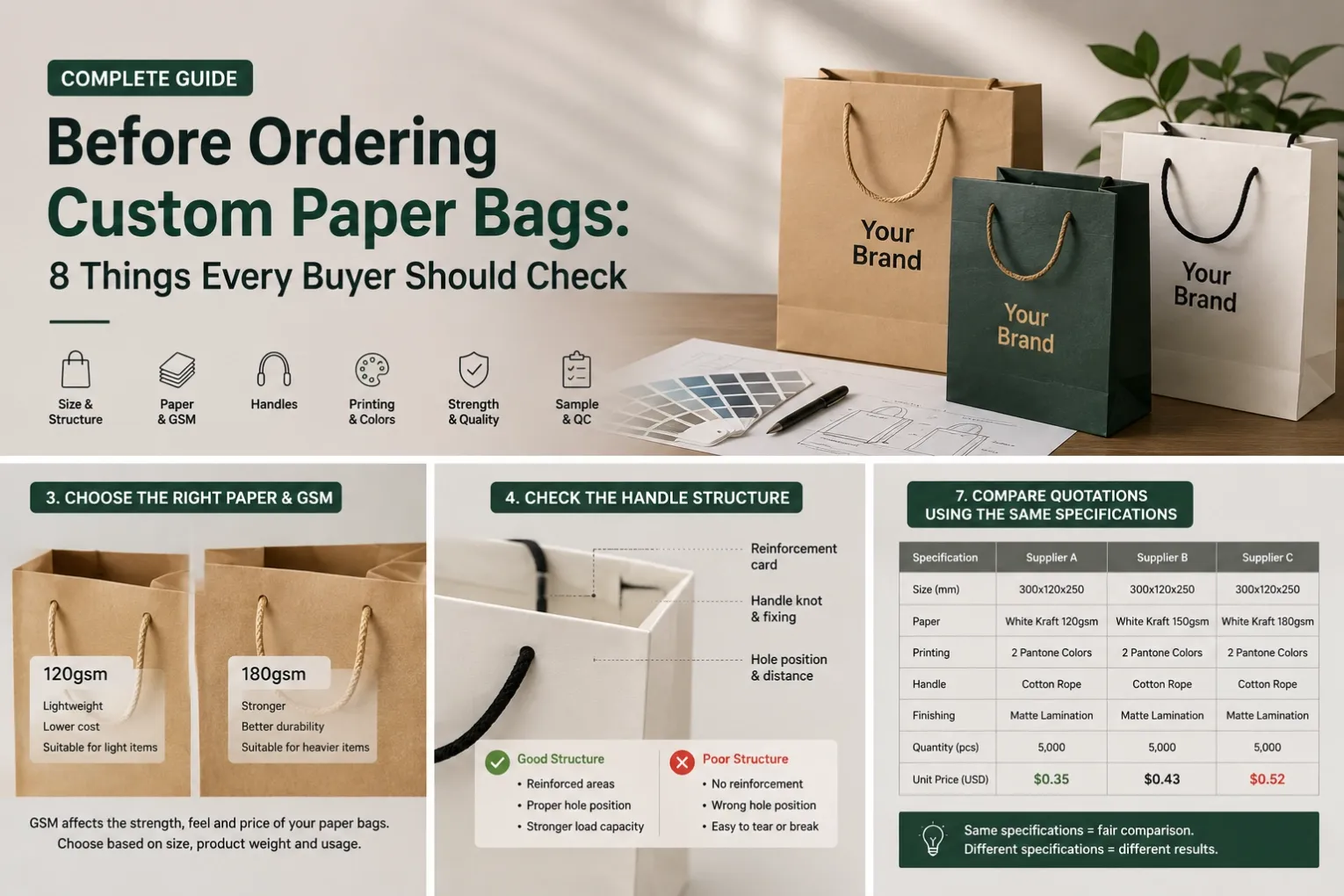
Custom paper bags may look like a simple packaging product, but small specification differences can have a big impact on quality, appearance and price.
Two paper bags may look almost identical in a quotation but use different paper weights, handle structures, printing methods or reinforcement.
That is why comparing only the unit price can be misleading.
Before ordering custom paper bags, here are 8 important details every buyer should check.
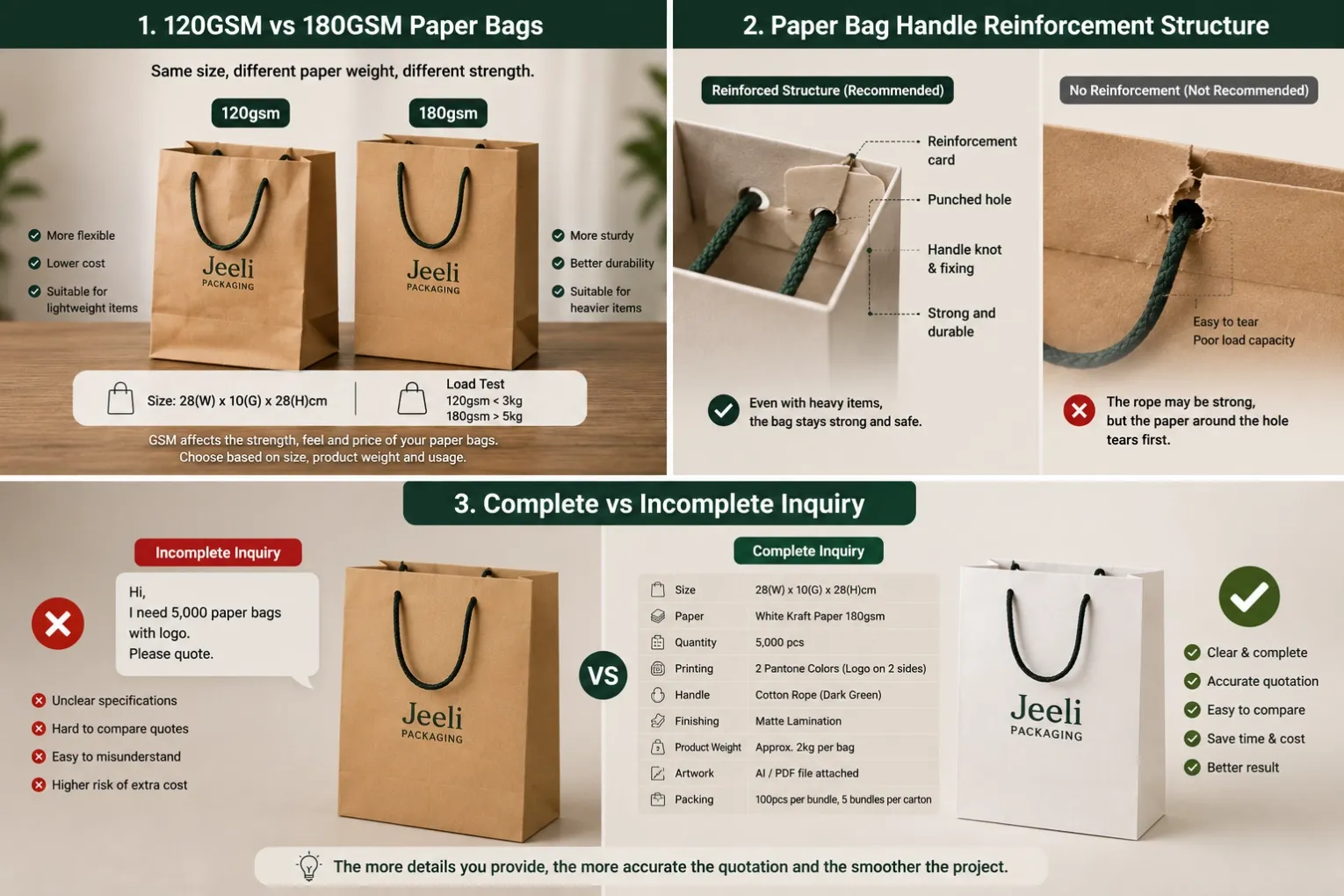
1. Confirm What Will Go Inside the Paper Bag
Before discussing paper, printing or handles, tell your supplier what the bag will actually carry.
For example:
- Clothing
- Cosmetics
- Shoe boxes
- Jewelry boxes
- Gift sets
- Food products
- Retail products
The product affects the required bag size, paper weight, handle structure and reinforcement.
A paper bag designed to carry a lightweight T-shirt does not need the same structure as a bag carrying a heavy gift box.
If possible, provide:
- Product dimensions
- Product weight
- Quantity packed in each bag
- Product photos
This gives the supplier much more information than simply saying:
“I need a custom paper bag.”
2. Don't Choose the Bag Size Too Quickly
A common mistake is choosing the paper bag size based only on the product dimensions.
The bag needs enough space for the product to be inserted and removed comfortably.
For a typical paper bag, you should confirm:
Width × Gusset × Height
The side gusset is especially important for boxes and wider products.
If your product already has retail packaging, provide the finished product or box dimensions to your supplier.
For important projects, testing the actual product inside a sample bag is even better. This can also reveal why paper shopping bags lose their shape after packing, especially when bag dimensions, product shape and load distribution do not work well together.
3. Choose the Right Paper and GSM
Paper weight is one of the most important specifications for custom paper bags.
Common paper options include:
- Brown kraft paper
- White kraft paper
- Coated paper
- Art paper
- Recycled paper
- Specialty paper
But material alone is not enough.
You also need to confirm the GSM (grams per square meter).
For example, two suppliers may both quote kraft paper bags, but one may use 120gsm paper while another uses 180gsm.
The bags will not have the same strength, feel or cost.
Higher GSM does not automatically mean better.
The right paper weight should depend on:
- Bag dimensions
- Product weight
- Required strength
- Desired appearance
- Handle structure
- Budget
This is why buyers should always compare quotations based on the same paper specification.
4. Check the Handle Structure — Not Just the Handle Material
Buyers often spend a lot of time choosing between:
- Cotton rope
- PP rope
- Ribbon
- Twisted paper handles
- Flat paper handles
- Die-cut handles
But the handle itself is only part of the structure.
You should also consider how the handle is attached to the bag.
For heavier products, reinforcement around the handle area may be necessary.
Otherwise, the rope may remain perfectly strong while the paper around the handle hole tears first.
For projects carrying heavier products, it is also important to evaluate the complete paper bag weight capacity, including the paper, handle attachment, reinforcement, bottom support and load distribution.
If you are experiencing this problem, see why paper bag handles tear or come loose and how attachment, reinforcement and load affect the finished bag.
When developing a paper bag for heavier products, ask your supplier about:
- Handle material
- Handle diameter
- Hole position
- Knot or fixing method
- Reinforcement card
- Load requirements
A beautiful handle means very little if the bag cannot safely carry the product.
5. Confirm Printing Colors on the Actual Paper
The same artwork can look different on different paper materials.
A color printed on white coated paper may look different when printed on brown kraft paper or textured specialty paper.
This is particularly important for brands with strict color requirements.
Before production, confirm:
- CMYK or Pantone colors
- Paper color
- Logo color
- Printing method
- Surface finishing
Do not rely only on how the artwork looks on a computer screen.
For projects with strict brand colors, a physical sample or color proof may be worth approving before mass production.
6. Check Finishing Around Folding Areas
Common options include:
- Hot foil stamping
- Embossing
- Debossing
- Spot UV
- Matte lamination
- Gloss lamination
- Soft-touch lamination
However, artwork and finishing should also consider the bag's folding and creasing areas.
Large solid-color areas or certain finishes positioned directly across folding and creasing areas may behave differently after converting and folding.
This should be considered during artwork review — not after the bags have already been produced.
A good supplier should review both the appearance and production feasibility of the artwork.
7. Compare Quotations Using the Same Specifications
Suppose you receive three quotations:
Supplier | Unit Price |
|---|---|
Supplier A | $0.35 |
Supplier B | $0.43 |
Supplier C | $0.52 |
It may seem obvious that Supplier A is the cheapest.
But not necessarily.
One quotation could be based on 120gsm paper, another on 150gsm and another on 180gsm.
There may also be differences in:
- Paper material
- Printing
- Lamination
- Handle material
- Reinforcement
- Finishing
- Packing method
- Quantity
Before comparing prices, make sure every supplier is quoting the same specification.
For a more accurate quotation, provide at least:
Size + Material/GSM + Quantity + Printing + Handle + Finishing
If you are unsure about GSM or material, tell the supplier what the bag will carry and ask for a recommendation.
8. Don't Approve a Sample Based Only on Appearance
When the sample arrives, it is easy to focus on one question:
“Does it look good?”
But a production sample should be checked for much more than appearance.
Before approving bulk production, check:
- Finished size
- Product fit
- Paper material
- Paper thickness
- Printing color
- Logo position
- Handle
- Reinforcement
- Folding
- Finishing
- Load performance
Put the actual product inside the bag and carry it.
This simple test can reveal problems that are difficult to identify from photos or artwork.
A Complete Inquiry Makes Quotation Easier
If you are preparing an inquiry for custom paper bags, providing complete information can save a lot of back-and-forth communication.
A useful inquiry could look like this:
Bag Size: 300 × 120 × 250 mm
Material: 180gsm white kraft paper
Quantity: 5,000 pcs
Printing: 2 Pantone colors
Handle: Cotton rope
Finishing: Matte lamination
Product Weight: Approx. 1.5 kg
Artwork: PDF/AI file available
Don't know all these specifications?
That is also fine.
Start with your product dimensions, approximate weight, quantity, logo and desired appearance. An experienced packaging supplier should be able to help recommend suitable specifications.
Final Thoughts
Good custom paper bags are not determined by appearance alone.
The right combination of size, paper GSM, printing, handles, reinforcement and finishing determines whether the finished bag looks good, performs properly and stays within budget.
Before comparing quotations or approving production, make sure the specifications are clear and consistent.
This makes it much easier to compare suppliers fairly and reduces the risk of unexpected problems during mass production.
If you are developing custom paper bags with your logo, Jeeli Packaging can help review your size, material, GSM, printing and finishing requirements before sampling and production.
Need a Quote for Custom Paper Bags?
Send us your:
- Bag size
- Quantity
- Product weight
- Logo or artwork
- Preferred material
- Handle style
- Printing and finishing requirements
If you are unsure about paper GSM or structure, simply send us your product information and photos.
We can recommend a suitable custom paper bag specification for your project.