
Oct 12, 2026Buying Guides
What Corrugated Thickness Should You Choose for Mailer Boxes? E-Flute vs B-Flute
Not sure which corrugated thickness to use for mailer boxes? Compare E-Flute and B-Flute for thickness, protection, printing and different product needs.
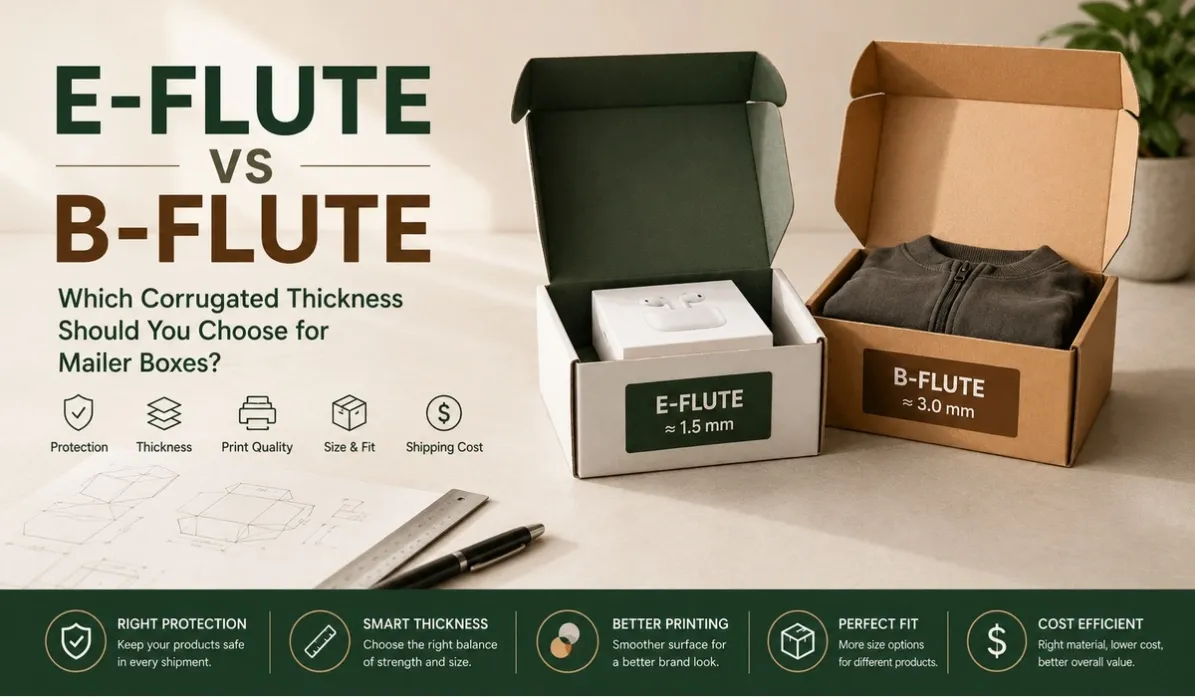
You need a custom mailer box for your product.
You send the size, quantity and logo to your packaging supplier.
Then your supplier asks:
“Do you need E-Flute or B-Flute?”
If you're not a packaging specialist, you may have no idea what that means.
That's completely normal.
Many buyers know the box style they want but don't know which corrugated thickness is suitable for their product.
In simple terms, E-Flute and B-Flute refer to different corrugated board structures commonly used to make mailer boxes.
The choice affects:
- Box thickness
- Product protection
- Structural strength
- Printing appearance
- Finished box size and feel
- Packaging cost
And the thicker option isn't automatically the better option.
The goal is to choose a board that provides enough protection without making the packaging unnecessarily heavy or bulky.
First, What Does "Flute" Actually Mean?
Look at the edge of a piece of corrugated cardboard.
You will see a wavy paper layer between the flat paper layers.
That wavy layer is called the flute.
Different flute types have different heights and structures.
For custom corrugated mailer boxes, two commonly used options are:
- E-Flute
- B-Flute
You don't need to become a packaging engineer to choose between them.
The easiest way to understand the difference is:
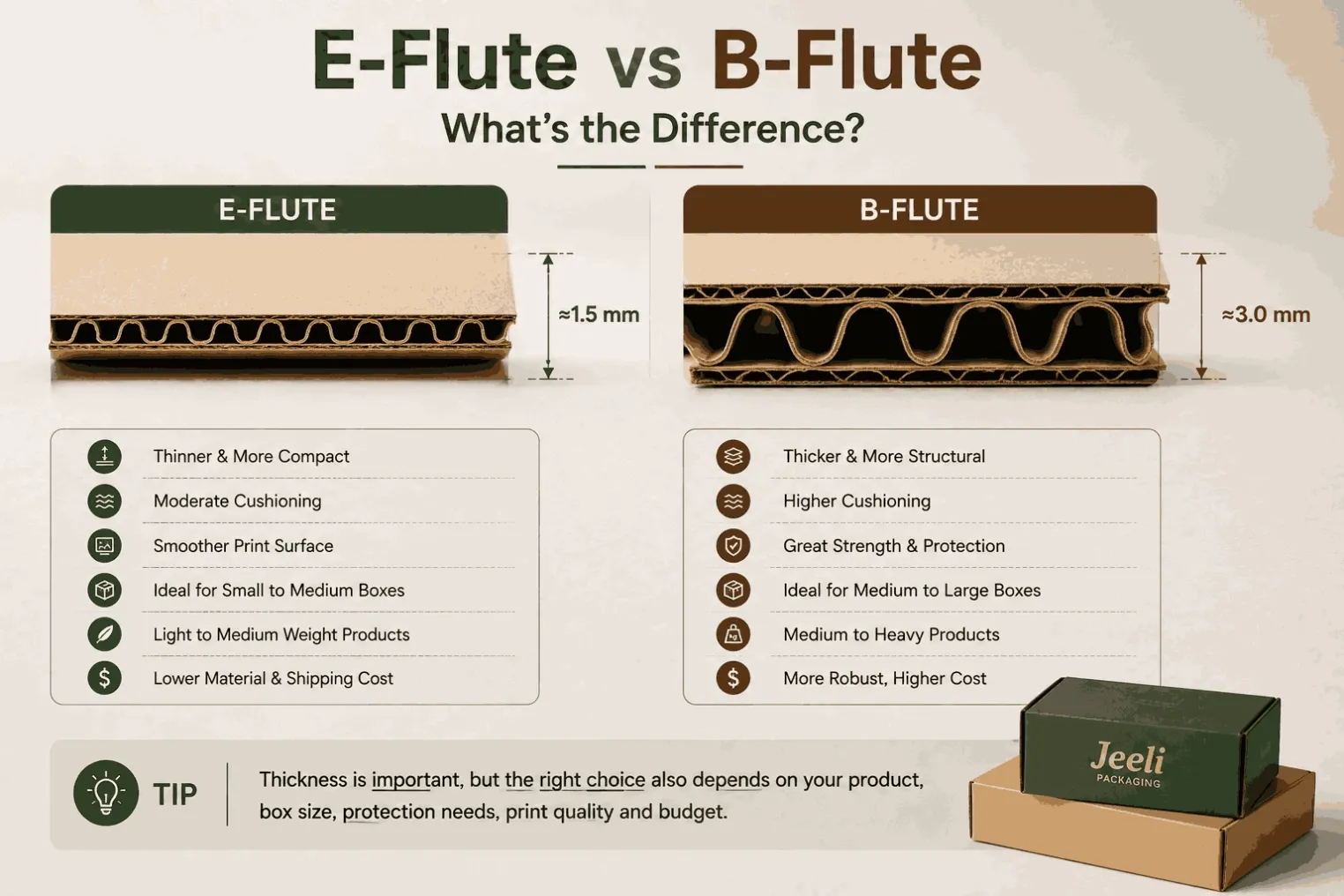
E-Flute is thinner and more refined. B-Flute is thicker and provides more cushioning.
If you are selecting packaging for an actual product, compare our Corrugated Mailer Boxes for standard corrugated structures or Custom Corrugated Mailer Boxes for custom sizing, printing and shipping requirements.
E-Flute vs B-Flute: What's the Difference?
Here is a simple comparison for buyers:
Feature | E-Flute | B-Flute |
|---|---|---|
Typical Thickness | Around 1.5 mm | Around 3 mm |
Overall Feel | Thinner and more compact | Thicker and more structural |
Cushioning | Moderate | Higher |
Print Presentation | Generally smoother | Good, but thicker in appearance |
Typical Box Size | Small to medium | Medium to larger |
Typical Product Weight | Light to medium | Medium to heavier |
Common Applications | Electronics, cosmetics, accessories | Shoes, apparel sets, larger products |
These thicknesses are approximate.
Actual corrugated board thickness can vary depending on the paper combination and board construction.
So instead of treating 1.5 mm or 3 mm as a fixed specification, use them as a starting point when discussing your packaging with a supplier.
When Should You Consider E-Flute?
E-Flute is a popular choice when buyers want the protection of corrugated packaging without making the box feel too thick.
It is often suitable for:
- Earbuds
- Chargers
- Cables
- Small electronics
- Cosmetics
- Jewelry
- Fashion accessories
- Small gifts
- Lightweight consumer products
For these products, the packaging often needs to achieve two things:
Protection + Presentation
A very thick corrugated structure may not always be necessary.
Example: Packaging Wireless Earbuds
Imagine you are packaging a small pair of wireless earbuds.
The product itself is:
- Small
- Relatively lightweight
- Protected by an internal insert
If the box is also relatively small, E-Flute may already provide sufficient structural support.
Using a much thicker board doesn't automatically make the packaging better.
It may simply make the finished box feel heavier and bulkier.
This is why material selection should start with the actual product, not simply with the assumption that thicker is safer.
When Should You Consider B-Flute?
B-Flute is thicker and generally provides more cushioning and structural support.
It may be worth considering for:
- Shoes
- Apparel sets
- Subscription boxes
- Larger accessories
- Heavier products
- Larger mailer boxes
- Products requiring additional protection
For example, a large mailer box containing shoes places very different demands on the corrugated board compared with a small box containing earbuds.
In this situation, the additional thickness of B-Flute may provide useful structural strength.
But remember:
B-Flute isn't automatically better just because it is thicker.
The correct choice depends on what the box actually needs to do.
Don't Choose Mailer Box Thickness by Product Type Alone
This is an easy mistake to make.
You might hear:
“Electronics use E-Flute.”
or:
“E-commerce boxes should use B-Flute.”
These statements are too general.
Consider two electronic products.
Product A
Wireless earbuds
Small box
Lightweight product
Paper insert inside
Product B
Larger electronic device
Larger box
Heavier product
More protection required
Both are electronic products.
But they may require completely different corrugated structures.
That's why your supplier should consider more than the product category.
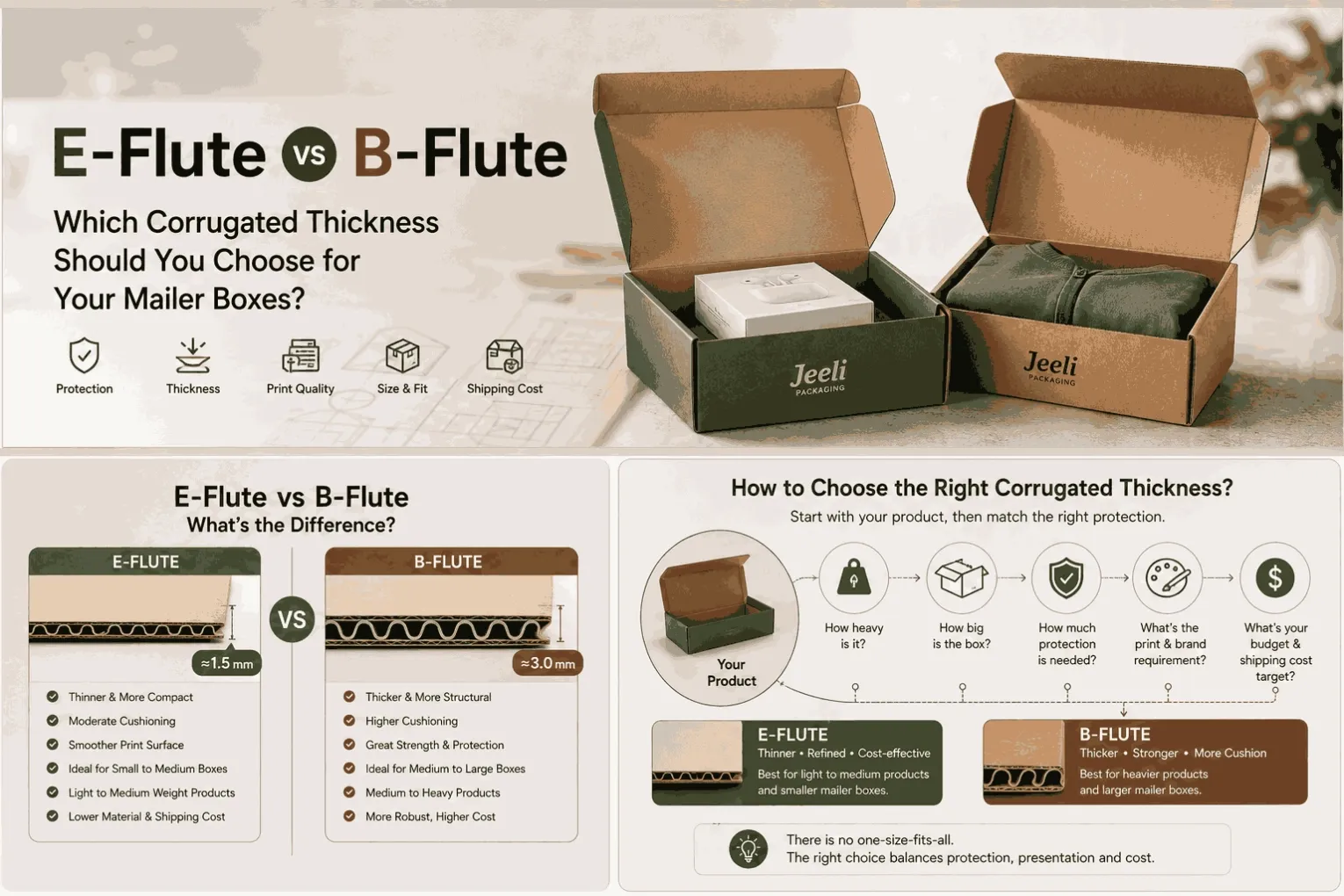
1. Start With Product Weight
One of the most useful pieces of information you can give your packaging supplier is:
How much does the product weigh?
A lightweight product puts relatively little pressure on the box.
A heavier product creates more stress on:
- Bottom panels
- Side walls
- Corners
- Locking tabs
- Folding areas
For a small lightweight product, E-Flute may be enough.
For a heavier product, a stronger corrugated structure may be more appropriate.
This is why sending only the box dimensions isn't always enough for a supplier to recommend the material.
2. Box Size Is Just as Important
Now imagine two mailer boxes.
Box A
150 × 100 × 50 mm
Box B
450 × 350 × 120 mm
Even if both boxes carry relatively lightweight products, they don't behave in exactly the same way.
The larger box has larger panels.
Large panels can be more likely to:
- Bend
- Flex
- Lose shape
- Compress during stacking
So when selecting mailer box thickness, the supplier should evaluate:
Product weight + Box dimensions + Box structure
rather than looking at only one specification.
3. How Fragile Is the Product?
Next, consider what happens if the box is dropped, squeezed or moved during transportation.
A T-shirt and a glass cosmetic bottle may have similar packaging dimensions.
But their protection requirements are completely different.
Ask:
- Can the product break?
- Can it be scratched?
- Can it be crushed?
- Does it contain delicate components?
- Does it need cushioning?
A fragile product may require more protection.
But that protection doesn't necessarily have to come only from thicker corrugated board.
Which leads to another important question.
4. Does the Product Have an Insert?
Imagine a small electronic product inside a mailer box.
There is a lot of empty space around it.
During transportation, the product moves from side to side.
A buyer may think:
“We need a thicker box.”
But the real problem may be:
The product doesn't fit properly inside the box.
In this case, increasing the corrugated thickness may not solve the problem.
A better solution could be:
- Reducing the box size
- Adding a paper insert
- Adding a corrugated insert
- Improving the internal structure
- Changing the product loading direction
The outer mailer box and the internal packaging should work together.
A thicker box cannot fix a poor internal fit.
5. Think About How the Box Will Be Shipped
Not every mailer box experiences the same transportation conditions.
This is very important.
Situation A: Product Packaging
The printed mailer box contains the product.
Several mailer boxes are then packed inside a larger master shipping carton.
In this case, the master carton provides additional transportation protection.
Situation B: Direct Shipping Packaging
The mailer box itself is sent directly through a courier or delivery network.
Now the box may experience:
- Stacking
- Compression
- Repeated handling
- Drops
- Surface abrasion
- Longer transportation
These two situations may require different packaging specifications.
So when requesting a quotation, tell your supplier:
Will this mailer box be packed inside a master carton, or shipped directly to the customer?
That one detail can make a big difference.
6. Don't Forget the Printing Appearance
Protection isn't the only reason to choose a particular corrugated board.
For branded mailer boxes, appearance matters too.
E-Flute has a finer corrugated structure and is often selected when buyers want a relatively compact, refined box.
This can be useful for:
- Cosmetics
- Fashion accessories
- Small electronics
- Jewelry
- Gift products
- Premium e-commerce packaging
B-Flute can also be custom printed, but the overall box feels thicker and more structural.
So the decision may sometimes involve a trade-off between:
Presentation
and
Additional cushioning / structural strength
Neither is automatically more important.
It depends on the product.
7. Thicker Doesn't Always Mean Better
This is probably the most important point in this article.
When buyers are uncertain about packaging materials, it is natural to think:
“Let's use the thicker one to be safe.”
But over-specifying packaging can create its own problems.
A thicker board may mean:
- More material
- A bulkier finished box
- More storage space
- Different folding performance
- Potentially higher packaging cost
If E-Flute already provides sufficient protection, moving to B-Flute may not create meaningful additional value.
But the opposite is also true.
Choosing a thinner material only because the quotation is cheaper can become expensive if boxes are damaged during packing or transportation.
The objective isn't:
Choose the thinnest board.
And it isn't:
Choose the thickest board.
The objective is:
Choose enough protection for the actual product and shipping conditions.
A Simple Buyer Example
Imagine you are sourcing packaging for two products.
Project A: Wireless Earbuds
- Product weight: 180 g
- Small packaging size
- Paper insert
- Full-color printed box
- Packed inside master cartons
- Premium retail presentation important
Starting point: E-Flute may be worth considering.
Why?
The product is relatively small and lightweight, while the insert provides additional internal support.
Project B: Footwear
- Product weight: 1.2 kg
- Larger packaging size
- No rigid internal insert
- E-commerce distribution
- More structural support required
Starting point: B-Flute may be worth considering.
Why?
The product is heavier, the box is larger and the packaging requires more structural support.
These examples show why there is no single "best" flute for every mailer box.
E-Flute or B-Flute? Use This Simple Checklist
If you are not sure which one to choose, start with these questions.
E-Flute may be worth considering if:
- Your product is relatively small
- Your product is lightweight to medium weight
- The box is small or medium-sized
- A refined printed appearance is important
- An insert provides internal support
- The mailer box will be packed inside a master carton
B-Flute may be worth considering if:
- Your product is heavier
- Your box is relatively large
- More cushioning is required
- Structural strength is a higher priority
- The box may experience more demanding handling
These are guidelines—not fixed rules.
The final material should be confirmed according to the actual project.
What Should You Send Your Supplier for an Accurate Recommendation?
You don't necessarily need to tell your supplier:
“I need E-Flute.”
If you aren't sure, let the packaging supplier recommend it.
Instead, provide the information they actually need.
Information | Example |
|---|---|
Product | Wireless earbuds |
Product Dimensions | 85 × 60 × 30 mm |
Product Weight | 180 g |
Box Size | If already confirmed |
Quantity | 3,000 pcs |
Printing | Full-color outside |
Insert | Paper insert required |
Sales Channel | Retail + E-commerce |
Shipping | Packed inside master cartons |
Reference | Product photo / existing packaging |
This gives the supplier much more useful information than:
“Please quote 3,000 mailer boxes.”
If you're not a packaging expert, you shouldn't need to choose every technical specification yourself.
A good supplier should help translate your product requirements into an appropriate packaging specification.
Final Thoughts
You don't need to understand every technical detail of corrugated packaging before requesting a quote.
But understanding one basic principle can help:
E-Flute is generally thinner and more refined, while B-Flute is generally thicker and offers more cushioning.
Which one should you choose?
That depends on:
- Product weight
- Product size
- Box dimensions
- Product fragility
- Internal insert
- Printing requirements
- Sales channel
- Shipping conditions
The best mailer box isn't necessarily the thickest one.
It's the one that gives your product the right balance of:
Protection + Presentation + Practicality + Cost
Not Sure Which Mailer Box Thickness You Need?
If you have a product but aren't sure whether E-Flute, B-Flute or another corrugated structure is suitable, you don't need to guess.
Send us:
- Product photo
- Product dimensions
- Product weight
- Required quantity
- Packaging reference
- Artwork or logo
- Shipping method
We can review the application and recommend a suitable corrugated mailer box structure before quotation.
If you are still comparing structure and material options, start from our custom mailer boxes page to review available box styles, corrugated materials and printing choices.