
Oct 12, 2026Buying Guides
What Should Fashion Designers Put on a Hang Tag — and What Should They Leave Off?
What should go on fashion hang tags? Learn which details belong on the main tag, what can move to a secondary tag, and what designers should leave off.
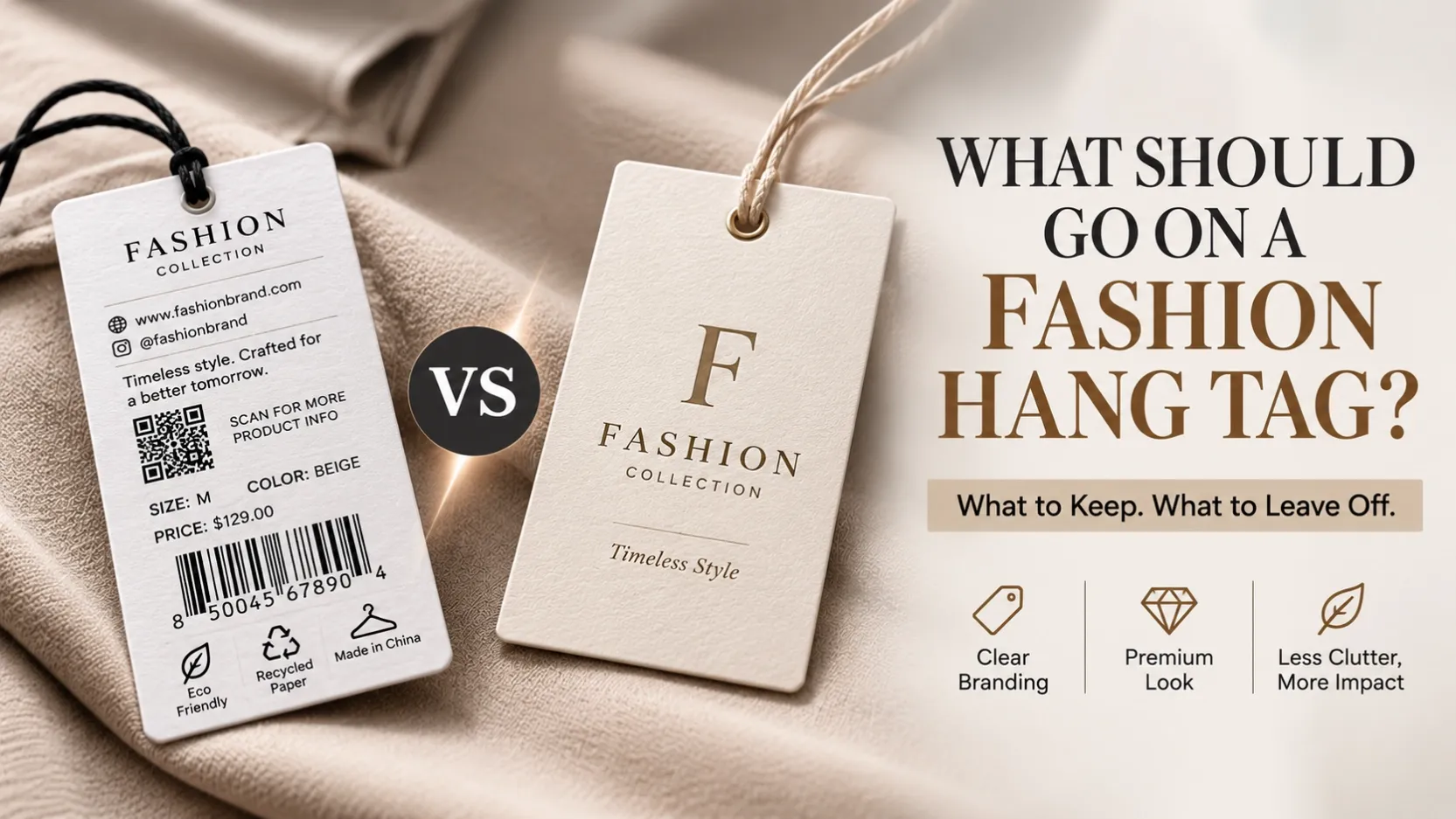
A fashion hang tag may only be a few centimeters wide.
But designers often try to make it do too many jobs.
Logo.
Brand story.
Website.
Social media.
Size.
Price.
Barcode.
QR code.
Product information.
Sustainability message.
Country of origin.
Before long, a clean fashion hang tag starts looking more like a small instruction sheet.
So what actually belongs on a hang tag?
And just as importantly:
What should you leave off?
For fashion designers and buyers, the goal isn't to fit as much information as possible onto the tag.
The goal is to decide which information deserves attention, which information is necessary, and which information can live somewhere else.
1. Start With the Job of the Hang Tag
Before deciding what to print, ask a simple question:
What is this hang tag supposed to do?
Different tags serve different purposes.
A main brand tag may focus on presentation and brand identity.
A retail tag may need a barcode, SKU and price.
A secondary tag may explain materials, craftsmanship or sustainability.
A promotional tag may use a QR code to connect customers with online content.
Trying to make one tag perform every function often creates unnecessary visual clutter.
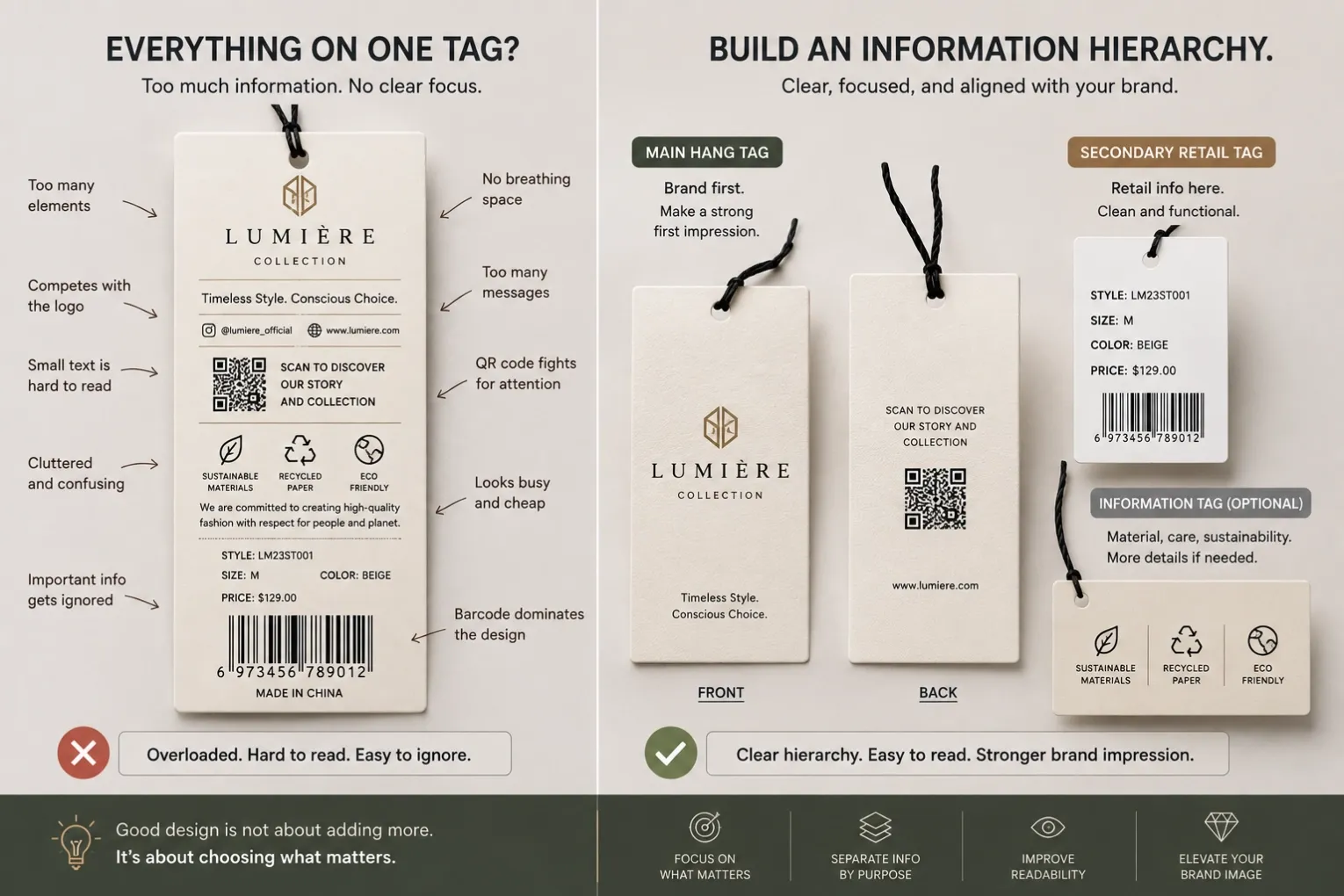
For many fashion brands, a better approach is to create an information hierarchy.
For example:
Main Fashion Hang Tag
- Brand logo
- Short brand message
- Website or QR code
Secondary / Retail Tag
- Product name
- Size
- SKU
- Barcode
- Price
Additional Information Tag
- Material story
- Sustainability information
- Special product features
Not every brand needs three tags.
The point is simple:
Don't assume everything has to fit on one tag.
2. Your Brand Logo Usually Deserves Priority
For most fashion hang tags, the logo is the most important visual element.
Customers may only interact with the tag for a few seconds.
The brand should therefore be easy to recognize.
That doesn't mean the logo needs to fill the entire tag.
In fact, generous empty space around a smaller logo can sometimes create a stronger premium impression than making the logo extremely large.
Think about hierarchy:
What should customers notice first?
If the answer is your brand, make sure other information isn't competing with it.
3. Keep the Brand Message Short
A hang tag can communicate more than a logo.
But it isn't usually the best place for a long company introduction.
Compare:
"Founded with a passion for creating timeless clothing using carefully selected materials and responsible manufacturing processes..."
with:
Designed to Last.
The second message is easier to notice and remember.
If your brand story requires several paragraphs, consider moving the full story to your website.
Your fashion hang tag can introduce the story without telling the entire story.
4. Should You Put Your Website or Social Media on the Hang Tag?
Usually, you don't need everything.
Printing:
www.example.comInstagram: @exampleTikTok: @exampleFacebook: exampleplus a QR code may be unnecessary.
Ask where you actually want the customer to go.
If your website is the main destination, a simple website address may be enough.
If a QR code leads directly to the most useful content, you may not need several social media handles beside it.
Every additional line of information uses valuable space.
For a clean fashion hang tag design, choose the most important destination rather than listing every possible channel.
5. QR Codes Can Replace Information — Not Just Add More
This is where QR codes can be especially useful.
Instead of trying to print an entire brand story or detailed product information on a small tag, a QR code can direct customers to:
- Brand story
- Product information
- Styling ideas
- Collection page
- Material details
- Authentication page
- Sustainability information
- Care information
But there's an important design principle here:
If the QR code moves information online, remove that information from the tag.
Don't add a QR code and then keep all the same information beside it.
Otherwise, the QR code creates more clutter instead of reducing it.
And always make sure the final printed QR code is large enough, has sufficient contrast, and can be scanned reliably.
6. Does the Price Need to Be on the Main Fashion Hang Tag?
Not necessarily.
For many retail products, price information is important.
But it doesn't always need to be integrated into the primary branded design.
A fashion brand might use:
Main Tag:
Logo + branding
Secondary Retail Tag:
Barcode + SKU + price + size
This can be particularly useful when the same main custom fashion hang tags are used across different products, markets or collections.
The branded tag stays visually consistent.
Variable retail information can then be handled separately.
7. Barcodes and SKUs Are Important — But They Don't Need to Dominate
From a retail and inventory perspective, barcodes and SKUs can be essential.
From a branding perspective, they aren't usually the most attractive elements.
That's where hierarchy becomes important again.
If the barcode must be included, give it enough space to function properly without allowing it to dominate the front of the tag.
Depending on the design, it can be placed:
- On the back
- On a secondary tag
- In a clearly separated information area
A functional element should remain functional.
But it doesn't necessarily need to become the main visual element.
8. Be Careful With Sustainability Claims
Fashion brands increasingly want to communicate environmental information.
You may want to mention:
- Recycled materials
- Responsible sourcing
- Recyclability
- Reduced packaging
- Sustainable collections
But a small fashion hang tag isn't the place to make vague or overly broad claims.
Statements such as:
100% Eco-Friendly
or
Completely Sustainable
may sound attractive, but environmental claims should be specific and supportable.
If the sustainability story requires explanation, the tag can provide a short factual statement and direct the customer to more detailed information.
For example:
Tag made with recycled paper.
Then a QR code can lead to further information if needed.
Simple, specific information is usually more useful than a long list of environmental buzzwords.
9. Does "Made in..." Belong on the Hang Tag?
This depends on the product, destination market and applicable labeling requirements.
Fashion designers shouldn't treat the hang tag as a substitute for required product labeling.
Some information may belong on:
- Sewn-in labels
- Care labels
- Product packaging
- Retail labels
- Other required documentation
rather than on the main branding tag.
Before finalizing artwork, buyers should confirm which information is legally required for their specific product and market.
Then decide where that information needs to appear.
Don't add regulatory information to the main hang tag simply because "other brands do it."
10. Don't Repeat Information That's Already Somewhere Else
This is one of the easiest ways to simplify a hang tag.
Imagine a garment already has a sewn-in label showing:
- Brand
- Size
- Material composition
- Care instructions
- Country information
Do all of those details need to be repeated on the main hang tag?
Maybe not.
Likewise, if a secondary retail tag already contains the barcode, SKU and price, you may not need them on the branded tag.
Look at the entire labeling system, not just one piece.
This helps reduce repetition and gives the main fashion hang tag more room to communicate the brand.
11. More Information Doesn't Make a Brand Look More Professional
This is an important design trap.
Sometimes buyers worry that empty space makes a tag look unfinished.
So they keep adding information.
A slogan.
An Instagram handle.
A website.
A QR code.
A sustainability icon.
Three certifications.
A brand story.
A barcode.
Eventually, almost every available space is filled.
But particularly for premium fashion brands, white space is part of the design.
It gives important elements room to breathe.
You don't need to fill every centimeter simply because printing space is available.
12. Think About the Front and Back as Two Different Spaces
One simple solution is to give each side a different purpose.
For example:
Front
Brand first
- Logo
- Collection name
- Short message
Back
Information second
- Website
- QR code
- Product information
- Barcode or SKU if required
This keeps the first impression clean while still giving buyers and customers access to useful information.
For many fashion hang tags, this is more effective than trying to mix branding and technical information together on both sides.
A Simple Example
Imagine a premium fashion brand trying to fit the following onto one tag:
- Logo
- Brand story
- Website
- QR code
- Size
- Price
- SKU
- Barcode
- Sustainability statement
- Material information
Technically, it may all fit.
But should it?
A cleaner system could be:
Main Hang Tag
Front:
Logo
Back:
Short brand message + website or QR code
Secondary Retail Tag
Size + SKU + barcode + price
Product / Sustainability Information
QR code → detailed online page
The customer still has access to the information.
But the main tag remains visually focused.
Before Finalizing Your Fashion Hang Tag, Ask These 7 Questions
Before sending your design for production, ask:
- What is the main purpose of this tag?
- What should the customer notice first?
- Which information is truly necessary?
- Which information already appears elsewhere?
- Can longer information move online through a QR code?
- Should retail information be separated from brand information?
- Can anything be removed without reducing usefulness?
The seventh question is often the most valuable.
What can we remove?
Good design isn't only about deciding what to add.
It's also about knowing what not to add.
What Should You Leave Off?
There isn't one universal answer for every fashion brand.
But reconsider information that:
- Repeats what's already on another label
- Doesn't help the customer
- Doesn't support the brand
- Makes important information harder to notice
- Can be communicated more effectively online
- Is included simply because there's empty space
Every element should earn its place.
Final Thoughts
A fashion hang tag has limited space.
That's not necessarily a disadvantage.
Limitations force designers to establish priorities.
Your hang tag doesn't need to explain everything about your brand, product and supply chain.
It needs to communicate the right information at the right moment.
For many fashion brands, that means keeping the primary tag focused on brand identity while moving retail, technical or detailed information to secondary tags, labels or digital pages.
Before adding another line of text, another icon or another QR code, ask:
Does the customer really need this here?
Sometimes removing one element can improve a hang tag more than adding another finishing process.
Developing Custom Fashion Hang Tags?
If you're working on a new fashion hang tag design, we can help turn your artwork into a practical production solution—from paper and printing to finishing, string and multi-tag combinations.
Related Articles
- Before You Approve Your Hang Tag Artwork, Check These 8 Things